


Page 60 - 00 Volume 5 The Mine
P. 60
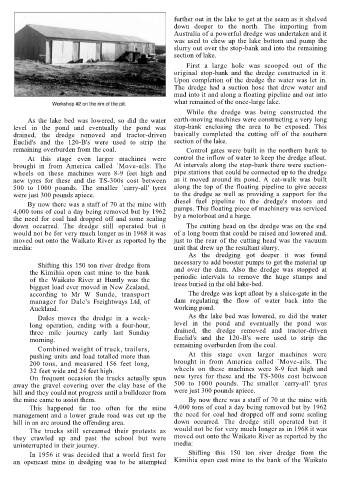
further out in the lake to get at the seam as it shelved
                                                              down  deeper  to  the  north.  The  importing  from
                                                              Australia of a powerful dredge was undertaken and it
                                                              was used to chew up the lake bottom  and pump the
                                                              slurry out over the stop-bank and into the remaining
                                                              section of lake.
                                                                  First  a  large  hole  was  scooped  out  of  the
                                                              original  stop-bank  and  the  dredge  constructed  in  it.
                                                              Upon completion of the dredge the water was let in.
                                                              The  dredge  had  a  suction  hose  that  drew  water  and
                                                              mud into it and along a floating pipeline and out into
                                                              what remained of the once-large lake.
                                                                  While  the  dredge  was  being  constructed  the
           As  the  lake  bed  was  lowered,  so  did  the  water  earth-moving machines were constructing a very long
      level  in  the  pond  and  eventually  the  pond  was  stop-bank  enclosing  the  area  to  be  exposed.  This
      drained,  the  dredge  removed  and  tractor-driven  basically  completed  the  cutting  off  of  the  southern
      Euclid's  and  the  120-B's  were  used  to  strip  the  section of the lake.
      remaining overburden from the coal.                         Control  gates  were  built  in the  northern bank  to
           At  this  stage  even  larger  machines  were  control the inflow of water to keep the dredge afloat.
      brought  in  from  America  called  `Move-ails.  The  At intervals along the stop-bank there were suction-
      wheels  on  these  machines  were  8-9  feet  high  and  pipe stations that could be connected up to the dredge
      new  tyres  for  these  and  the  TS-300s  cost  between  as  it  moved  around  its  pond.  A  cat-walk  was  built
      500  to  1000  pounds.  The  smaller  `carry-all'  tyres  along the top of the floating  pipeline to give access
      were just 300 pounds apiece.                            to the dredge as well as providing a  support  for  the
           By now there was a staff of 70 at the mine with    diesel  fuel  pipeline  to  the  dredge's  motors  and
      4,000 tons of coal a day being removed but by 1962      pumps. This floating piece of machinery was serviced
      the  need  for  coal  had  dropped  off  and  some  scaling   by a motorboat and a barge.
      down  occurred.  The  dredge  still  operated  but  it      The cutting head on the dredge was on the end
      would not be for very much longer as in 1968 it was  of a long boom that could be raised and lowered and,
      moved out onto the Waikato River as reported by the  just to the rear of the cutting head was the vacuum
      media:                                                  unit that drew up the resultant slurry.
                                                                   As  the  dredging  got  deeper  it  was  found
              Shifting  this  150  ton  river  dredge  from   necessary to add booster pumps to get the material up
           the Kimihia  open  cast  mine  to  the  bank       and  over  the  dam.  Also  the  dredge  was  stopped  at
           of  the  Waikato  River  at  Huntly  was  the      periodic  intervals  to  remove  the  huge  stumps  and
           biggest load ever moved in New Zealand,            trees buried in the old lake-bed.
           according  to  Mr  W  Sunde,  transport                 The dredge was kept afloat by a sluice-gate in the
           manager  for  Dale's  Freightways Ltd, of          dam  regulating  the  flow  of  water  back  into  the
           Auckland.                                          working pond.
                                                                   As  the  lake  bed  was  lowered,  so  did  the  water
              Dales  moves  the  dredge  in  a  week-
           long  operation,  ending  with  a  four-hour,      level  in  the  pond  and  eventually  the  pond  was
           three  mile  journey  early  last  Sunday          drained,  the  dredge  removed  and  tractor-driven
           morning.                                           Euclid's  and  the  120-B's  were  used  to  strip  the
              Combined weight of truck, trailers,             remaining overburden from the coal.
           pushing units  and load  totalled more  than            At  this  stage  even  larger  machines  were
           200  tons,  and  measured  156  feet  long,        brought  in  from  America  called  `Move-ails.  The
           32 feet wide and 24 feet high.                     wheels  on  these  machines  were  8-9  feet  high  and
           On  frequent  occasion  the  trucks  actually  spun   new  tyres  for  these  and  the  TS-300s  cost  between
      away  the  gravel  covering  over  the  clay  base  of  the   500  to  1000  pounds.  The  smaller  `carry-all'  tyres
      hill and they could not progress until a bulldozer from   were just 300 pounds apiece.
      the mine came to assist them.                                By now there was a staff of 70 at the mine with
           This  happened  far  too  often  for  the  mine  4,000 tons of coal a day being removed but by 1962
      management and a lower grade road was cut up the  the  need  for  coal  had  dropped  off  and  some  scaling
      hill in an arc around the offending area.               down  occurred.  The  dredge  still  operated  but  it
           The  trucks  still  screamed  their  protests  as   would not be for very much longer as in 1968 it was
      they  crawled  up  and  past  the  school  but  were    moved out onto the Waikato River as reported by the
                                                              media:
      uninterrupted in their journey.
           In 1956 it was decided that a world first for           Shifting  this  150  ton  river  dredge  from  the
      an  opencast  mine  in  dredging  was  to  be  attempted   Kimihia open cast mine to the bank of the  Waikato

