


Page 58 - 00 Volume 5 The Mine
P. 58
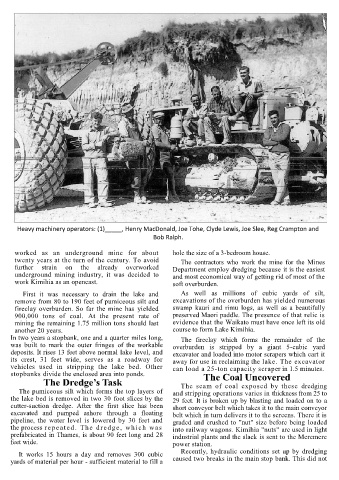
Heavy machinery operators: (1)_____, Henry MacDonald, Joe Tohe, Clyde Lewis, Joe Slee, Reg Crampton and

                                                       Bob Ralph.
      worked  as  an  underground  mine  for  about           hole the size of a 3-bedroom house.
      twenty years at the turn of the century. To avoid          The  contractors  who  work  the  mine  for  the  Mines
      further  strain  on  the  already  overworked           Department employ dredging because it is the easiest
      underground  mining  industry,  it  was  decided  to    and most economical way of getting rid of most of the
      work Kimihia as an opencast.                            soft overburden.
         First  it  was  necessary  to  drain  the  lake  and    As  well  as  millions  of  cubic  yards  of  silt,
      remove from 80 to 190 feet of pumiceous silt and        excavations of the overburden has yielded numerous
      fireclay overburden. So far the mine has  yielded       swamp  kauri  and  rimu  logs,  as  well  as  a  beautifully
      900,000  tons  of  coal.  At  the  present  rate  of    preserved Maori paddle. The presence of that relic is
      mining the remaining 1.75 million tons should last      evidence that the Waikato must have once left its old
      another 20 years.                                       course to form Lake Kimihia.
     In two years a stopbank, one and a quarter miles long,      The  fireclay  which  forms  the  remainder  of  the
     was  built  to  mark  the  outer  fringes  of  the  workable   overburden  is  stripped  by  a  giant  5-cubic  yard
     deposits. It rises 13 feet above normal lake level, and   excavator and loaded into motor scrapers which cart it
     its  crest,  31  feet  wide,  serves  as  a  roadway  for   away for use in reclaiming the lake. The excavator
     vehicles  used  in  stripping  the  lake  bed.  Other    can load a 25-ton capacity scraper in 1.5 minutes.

     stopbanks divide the enclosed area into ponds.                     The Coal Uncovered
                The Dredge’s Task                                The  seam  of  coal  exposed  by  these  dredging
        The pumiceous silt which forms the top layers of      and stripping operations varies in thickness from 25 to
     the lake bed is removed in two 30 foot slices by the     29 feet. It is broken up by blasting and loaded on to a
     cutter-suction  dredge.  After  the  first  slice  has  been   short conveyor belt which takes it to the main conveyor
     excavated  and  pumped  ashore  through  a  floating     belt which in turn delivers it to the screens. There it is
     pipeline,  the  water  level  is  lowered  by  30  feet  and   graded and crushed to "nut" size before being  loaded
     the process repeated. The dredge, which was              into railway wagons. Kimihia "nuts" are used in light
     prefabricated in Thames, is about 90 feet long and 28    industrial plants and the slack is sent to the Meremere
     feet wide.                                               power station.
        It  works  15  hours  a  day  and  removes  300  cubic   Recently, hydraulic conditions set up by  dredging
     yards of material per hour - sufficient material to fill a   caused two breaks in the main stop bank. This did not

