


Page 59 - 00 Volume 5 The Mine
P. 59
directly  affect  the  workings  but  it  necessitated  section of lake.
      extensive  investigations  and  repairs  costing  between   First  a  large  hole  was  scooped  out  of  the
      £80,000  and  £90,000.  Supplementary  stopbanks        original  stop-bank  and  the  dredge  constructed  in  it.
      were  built  to  provide  additional  protection  for  the   Upon completion of the dredge the water was let in.
      workings.  Experts  in  the  study  of  soil  stability   The  dredge  had  a  suction  hose  that  drew  water  and
      consider that the protection works now provide an       mud into it and along a floating pipeline and out into
      adequate  margin  of  safety.  Despite  this  setback
      Kimihia opencast mine remains one of New Zealand's      what remained of the once-large lake.
      most important coal producers.                              While  the  dredge  was  being  constructed  the
           Coal was also carried out of the district by rail   earth-moving machines were constructing a very long
      and  over  the  narrow,  but  well-gravelled  access  road   stop-bank  enclosing  the  area  to  be  exposed.  This
      that had been put in about 1944 to service the village.   basically  completed  the  cutting  off  of  the  southern
      From  the  lake  shore  the  road  curved  up  a  short  but   section of the lake.
      steep hill past the school and, during the winter, the      Control gates were built in the northern bank to
      heavily laden coal trucks made hard work of the hill    control the inflow of water to keep the dredge afloat.
      and regularly interrupted the schooling of the pupils as   At intervals along the stop-bank there were suction-
      they  ground  past  on  the  neighbouring  road  in  first   pipe  stations  that  could  be  connected  up  to  the
      gear with exhausts belching and engines roaring.        dredge as it moved around its pond. A cat-walk was
            On  frequent  occasion  the  trucks  actually  spun  built  along  the  top  of  the  floating  pipeline  to  give
      away  the  gravel  covering  over  the  clay  base  of  the  access  to  the  dredge  as  well  as  providing  a  support
      hill  and  they  could  not  progress  until  a  bulldozer  for  the  diesel  fuel  pipeline  to  the  dredge's  motors
      from the mine came to assist them.                      and  pumps.  This  floating  piece  of  machinery  was
            This  happened  far  too  often  for  the  mine  serviced by a motorboat and a barge.
      management and a lower grade road was cut up the            The cutting head on the dredge was on the end
      hill in an arc around the offending area.               of a long boom that could be raised and lowered and,
            The  trucks  still  screamed  their  protests  as   just to the rear of the cutting head was the vacuum
      they  crawled  up  and  past  the  school  but  were    unit that drew up the resultant slurry.
      uninterrupted in their journey.                              As  the  dredging  got  deeper  it  was  found
            In 1956 it was decided that a world first for  necessary to add booster pumps to get the material up
      an  opencast  mine  in  dredging  was  to  be  attempted  and  over  the  dam.  Also  the  dredge  was  stopped  at
      further out in the lake to get at the seam as it shelved  periodic  intervals  to  remove  the  huge  stumps  and
      down  deeper  to  the  north.  The  importing  from  trees buried in the old lake-bed.
      Australia of a powerful dredge was undertaken and it         The dredge was kept afloat by a sluice-gate in the
      was used to chew up the lake bottom  and pump the       dam  regulating  the  flow  of  water  back  into  the
      slurry out over the stop-bank and into the remaining    working pond.


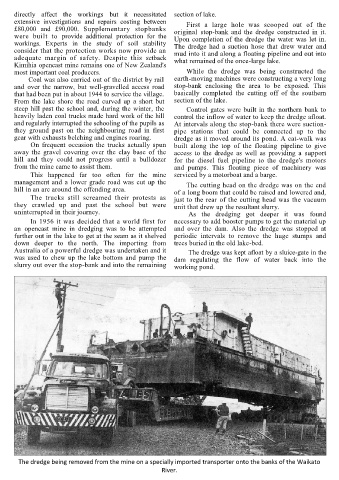
        The dredge being removed from the mine on a specially imported transporter onto the banks of the Waikato

                                                          River.

