


Page 56 - 00 Volume 5 The Mine
P. 56
TIME LOST
                                                                Considerable  time  has  been  lost  because  the
                                                             timber blocked the dredge pumps, which had smaller
                                                             impellor passages than intakes.
                                                                A floating sluicing plant was built to loosen the
                                                             stumps and logs and the timber was gathered up on a
                                                             barge. This method proved  satisfactory, he continued.
                                                             Larger stumps were dragged towards the stopbanks by
                                                             means of a tractor winch. Prolific growth of rushes on
                                                             the lake bed mud also contributed to stoppages  and
                                                             hormone spray was used with some success. New
                                                             pumps  with  larger  impellor  passages  had  been
                                                             ordered, Mr Nanson said.
                                                                Another setback was the collapse of the stopbank
                                                             between  the  present  dredging  pond  and  the  lake
                                                             proper.

                                                             The breaches had been repaired quickly with the aid
                                                             of  all  possible  land  equipment  pouring  soft  clay,
                                                             fireclay,  into  the  gaps  to  form  extra  banks  and
                                                             there  had  been  a  negligible  movement  of  water.
                                                             The lake was ept at a fairly constant level throughout
                                                             the project, Mr Nanson said.
                                                                         SCHEME CHECKED
                                                                The  Ministry  of  Works  had  been  called  in  to
                                                             examine  and  check  the  whole  scheme  after  the
                                                             stopbank failures to ensure the safety of the project in
                                                             view  of  the  huge  resources  at  stake.  Although  the
                                                             Department  of  Mines  had  not  received  the  final
                                                             recommendations from the Ministry of Works, Mr
                                                             Nanson  said  he  understood the present scheme was
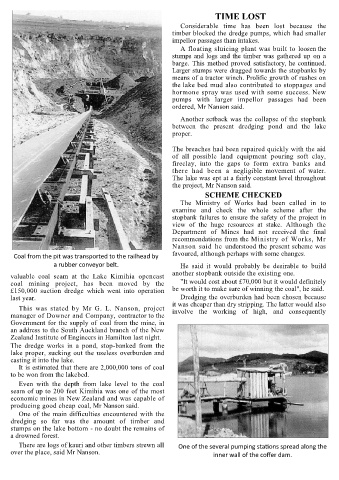
      Coal from the pit was transported to the railhead by   favoured, although perhaps with some changes.

                    a rubber conveyor belt.                     He  said  it  would  probably  be  desirable  to  build
     valuable  coal  seam  at  the  Lake  Kimihia  opencast   another stopbank outside the existing one.
     coal  mining  project,  has  been  moved  by  the          "It would cost about £70,000 but it would definitely
     £150,000  suction  dredge  which  went  into  operation   be worth it to make sure of winning the coal", he said.
     last year.                                                 Dredging the overburden had been chosen  because
        This  was  stated  by  Mr  G.  L.  Nanson,  project   it was cheaper than dry stripping. The latter would also
                                                             involve  the  working  of  high,  and  consequently
     manager of Downer and Company, contractor to the
     Government for the supply of  coal from the mine, in
     an address to the South Auckland branch of the New

     Zealand Institute of Engineers in Hamilton last night.
     The  dredge  works  in  a  pond,  stop-banked  from  the
     lake proper, sucking out the useless  overburden and
     casting it into the lake.
        It is estimated that there are 2,000,000 tons of coal
     to be won from the lakebed.
        Even  with  the  depth  from  lake  level  to  the  coal
     seam of up to 200 feet Kimihia was one of the most
     economic mines in New Zealand and was capable of
     producing good cheap coal, Mr Nanson said.
        One of the main difficulties encountered  with the
     dredging  so  far  was  the  amount  of  timber  and
     stumps on the lake bottom - no doubt the remains of
     a drowned forest.
        There are logs of kauri and other timbers strewn all    One of the several pumping stations spread along the

     over the place, said Mr Nanson.
                                                                            inner wall of the coffer dam.

